Putting It All Together

Meditation and hypnopompia share a powerful common feature: they quiet emotional reactivity and create a state of
peaceful clarity where the mind can perceive broader patterns, deeper truths, and more constructive possibilities,
restoring emotional stability, increasing peace, and supporting the conditions that allow genuine happiness to emerge.
Throughout history, people have used these states to access insight:
These states reveal what the mind can do when emotional reasoning is quiet and awareness expands beyond negative or
narrow patterns, creating space for broader truths, deeper relationships, and the larger systems we live in. They show
us the expanded mode of human reasoning, the mode capable of truth, responsibility, cooperation, environmental
awareness, and positive intention.
But openness is only possible when we understand the negative. Negative reasoning is not “bad.” It is simply past
conditioning, old emotional patterns repeating themselves. Understanding negativity allows the brain to reorient
toward positive reasoning.
This chapter is the gateway to everything that follows. Human societies and natural ecosystems collapse for the same reason: Remove the stabilizing forces → imbalance → runaway processes → collapse.
See video:
Sixth Extinction – Runaway processes
In nature, stabilizing forces are keystone species:
See video:
The Serengeti Rules
In humanity, stabilizing forces are keystone relational components:
See video:
The Rules for Rulers
This pattern affects all people, all groups, all communities, all nations, all ecosystems, and all species. It shapes
the future of humanity and the Earth.
Putting It All Together
Meditation, hypnopompia, and expanded human reasoning
Human systems and ecological systems share one pattern
Ecological keystone stabilizers
Human keystone relational stabilizers
See video:
Truth – Cue ball video
When stabilizers disappear, collapse becomes predictable
Across all chapters, one pattern repeats: emotion activates first, identity forms around it, group norms reinforce it, beliefs solidify from it, and selective reasoning protects it. This emotional sequence explains why people avoid truth, protect identity, and collapse attention into narrow priorities. Putting it all together means recognizing this sequence and choosing positive reasoning over emotional reactivity.
This sequence shapes how people reason, relate, take responsibility, form groups, manage conflict, care for the environment, educate children, build communities, and create or destroy solutions. Each chapter explored one part of this system; the final chapter shows how they work together.
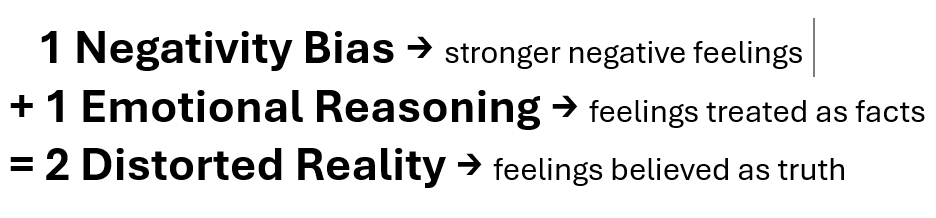
So, it becomes imperative for any person to become aware
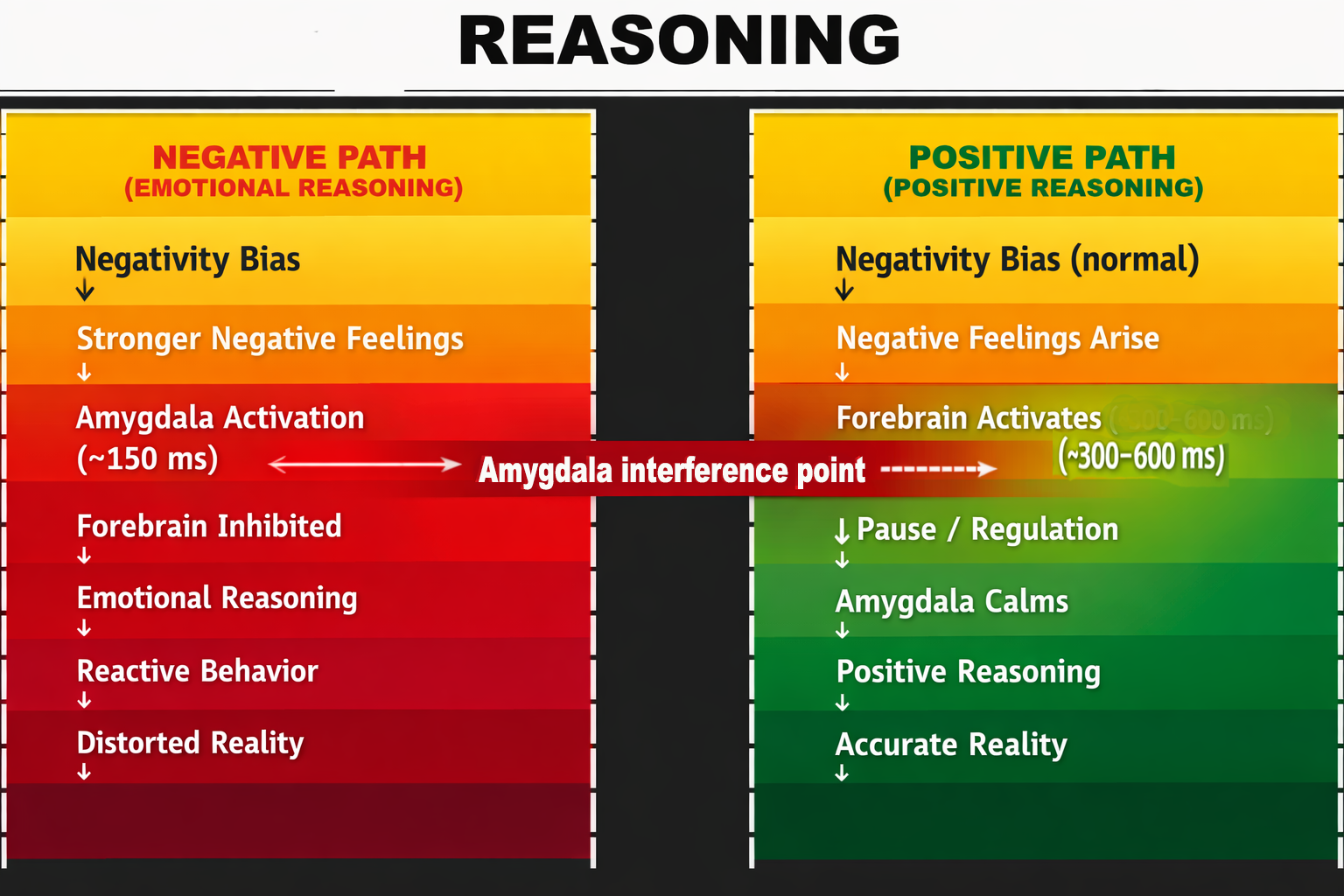
Negativity Bias (normal, universal)
Negative Emotion → Amygdala Activation (≈150 ms)
The amygdala fires before conscious thought, triggering:
This is automatic and evolutionarily ancient.
Forebrain (Reasoning) Arrives Late (≈300–600 ms)
The forebrain (especially the prefrontal cortex, the reasoning and planning center) is:
This creates a reaction window where negative emotion can dominate logic.
Emotional Reasoning Takes Over
If the reaction is not interrupted, the brain defaults to:
“I feel it, therefore it must be true.”
This is emotional reasoning; feelings treated as facts.
Reactive Behavior Occurs
Without regulation, the person:
This is the behavioral expression of the amygdala first sequence.
Learning to Manage Reactivity Is the Turning Point
This is where skill, practice, and responsibility enter:
These behaviors interrupt the amygdala → behavioral path. This is the choice point: whether the person continues in emotional reasoning or shifts into “positive reasoning. This choice point determines whether the person escalates into emotional reasoning or transitions into positive reasoning.
“Positive Reasoning” Becomes Possible
Once the amygdala settles and the forebrain comes online:
This requires a shift from reactive to reflective. Positive reasoning becomes possible only when the forebrain regains control and emotional reasoning is interrupted.
Calmness Is the Pathway
Remaining peaceful and calm is not passive. It is the condition that allows the reasoning brain to function.
Calmness = prefrontal cortex online
Reactivity = amygdala online
You can’t have both at the same time.
Calmness is not optional; it is the biological requirement for forebrain based reasoning.
Emotional reasoning collapses attention into a single priority: “me, my money, my land, my comfort.” When this collapse happens, people stop seeing systems, relationships, ecosystems, and long‑term consequences. Emotional reasoning feels like self‑protection, but it blinds people to truth and replaces reasoning with threat‑avoidance. This collapse has shaped land‑use decisions for more than a century. The original removal of bison from the Great Falls region was not based on ecological reasoning. It was a political strategy to control Native nations and replace a functioning prairie ecosystem with cattle. The land’s ecological purpose was overridden by a narrow human priority, and the region lost the American Serengeti that once defined it. Today, emotional reasoning continues the same pattern. Brucellosis is often used as the reason bison cannot share land with cattle, yet elk and deer also carry brucellosis and roam freely on the same federal lands where cattle graze. This contradiction reveals attentional collapse: the fear narrows to “bison threaten my cattle,” even though the ecological truth is broader and includes other animals. When attention collapses to a single symbolic threat, people stop noticing what is best for the land, the ecosystem, or the future. This narrow focus prevents communities from seeing the opportunity in front of them: restoring the American Serengeti would strengthen tourism, identity, ecological health, and long‑term prosperity in Great Falls. Bison restoration is not a threat, it is one of the region’s greatest potential assets. The same pattern appears everywhere: money-first thinking collapses attention to financial survival identity-first thinking collapses attention to “my group” comfort-first thinking collapses attention to avoiding discomfort Emotional reasoning always narrows attention. Positive reasoning always expands it. When people shift from emotional reasoning to calm, positive reasoning, they regain the ability to see multiple priorities at once; land health, community well‑being, ecological truth, long‑term prosperity, and shared responsibility. This expanded attention is the foundation of positive solutions and the path toward restoring what was lost.
The diagram below contrasts emotional and logical reasoning, showing how each unfolds over time and how recognizing the emotion shifts the process toward logic (green) rather than emotional reactivity (red).
Intention is a deliberate cognitive skill that keeps the forebrain engaged and reduces emotional hijack. Intention acts as the stabilizing force that prevents emotional hijack and maintains access to positive reasoning.
The positive reasoning path aligns with relational science by expanding awareness beyond self and restoring interdependence.
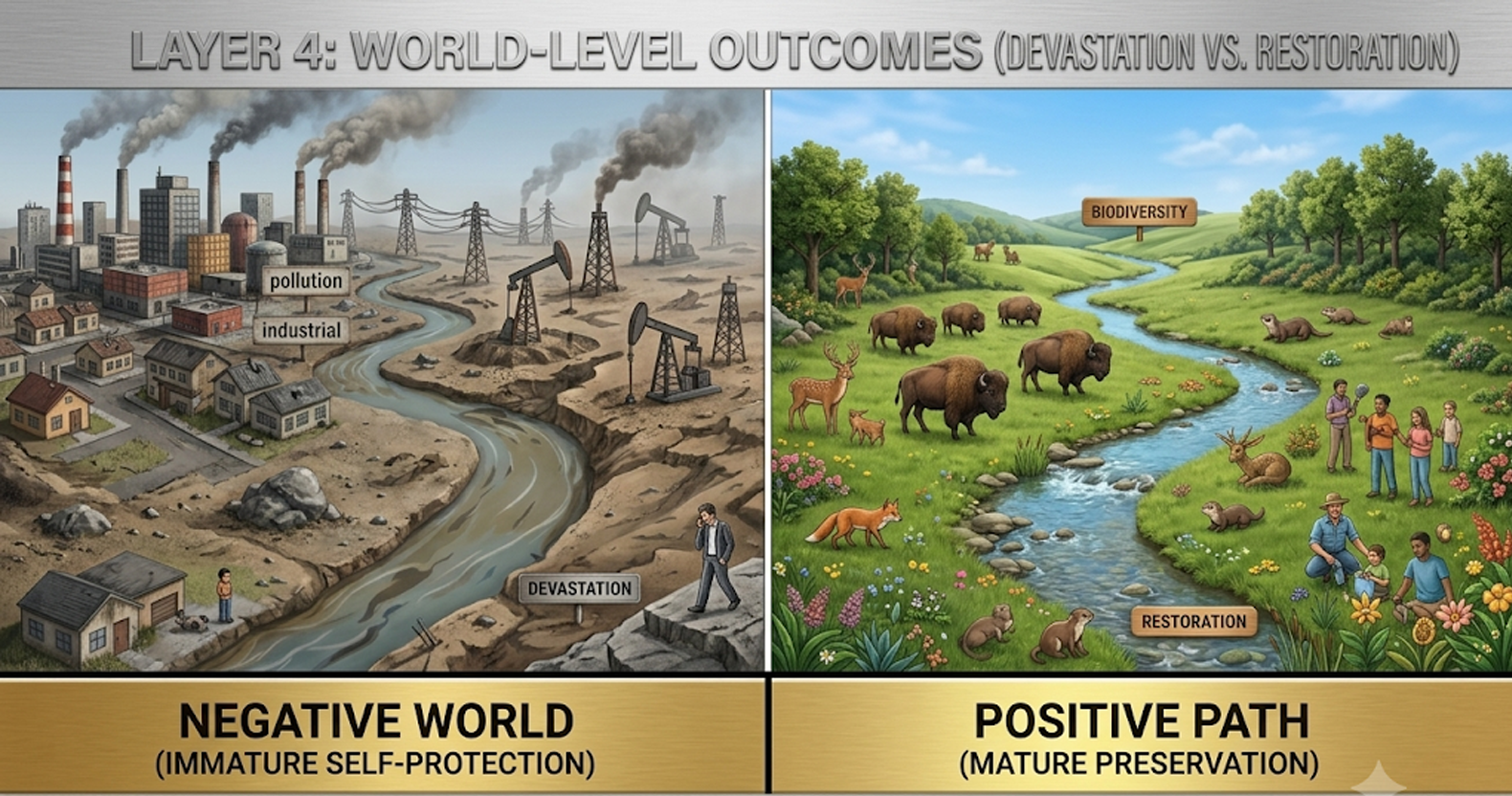
Self‑absorbed → my focus, attention (concerns, money, my family, community, nation)
Awareness of others, communities, nations, people, wildlife, biodiversity, environment, earth.
These societal collapses are the large scale expression of the same emotional reasoning patterns that occur in individual brains. The same emotional reasoning collapsed concern that operate in individual brains also scale up into group behavior, politics, and environmental decisions.
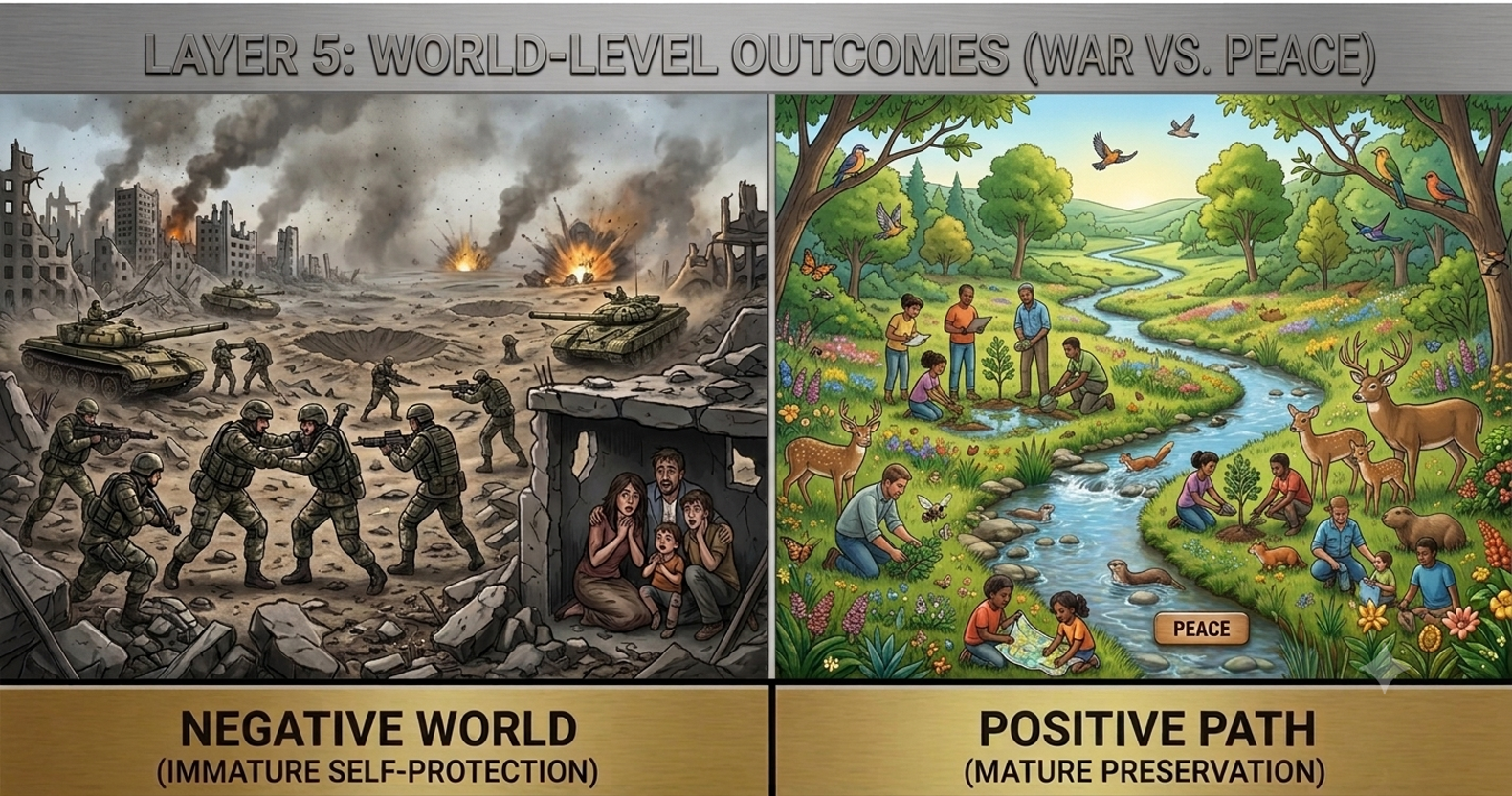
When emotional reasoning dominates at the societal level, long term ecological and societal conflict consequences are ignored, accelerating biodiversity loss, environmental collapse, harm, and loss of life.
So the primary problems creating war and environmental destruction are:
Absence of awareness of others, the environment, and interdependence
This is the collapse of interbeing. When people cannot perceive the field of relational science, they behave as if consequences don’t exist. This is foundational.
Choosing emotional reasoning of the group over independent logic
This is the collapse of reasoning. Group identity and emotional reasoning
overrides forebrain logic and creates:
This is the psychological engine of war.
Focus on money over reasoning
This is the collapse of attention. When attention narrows to money, people stop perceiving:
This is the economic engine of environmental destruction.
Following groupthink reasoning
This is the collapse of individual agency. Groupthink produces:
This is the social engine of war.
Immature self protection (the small circle of concern)
This is the root.
It is the psychological state where a person’s concern collapses to:
This is the primary cause of:
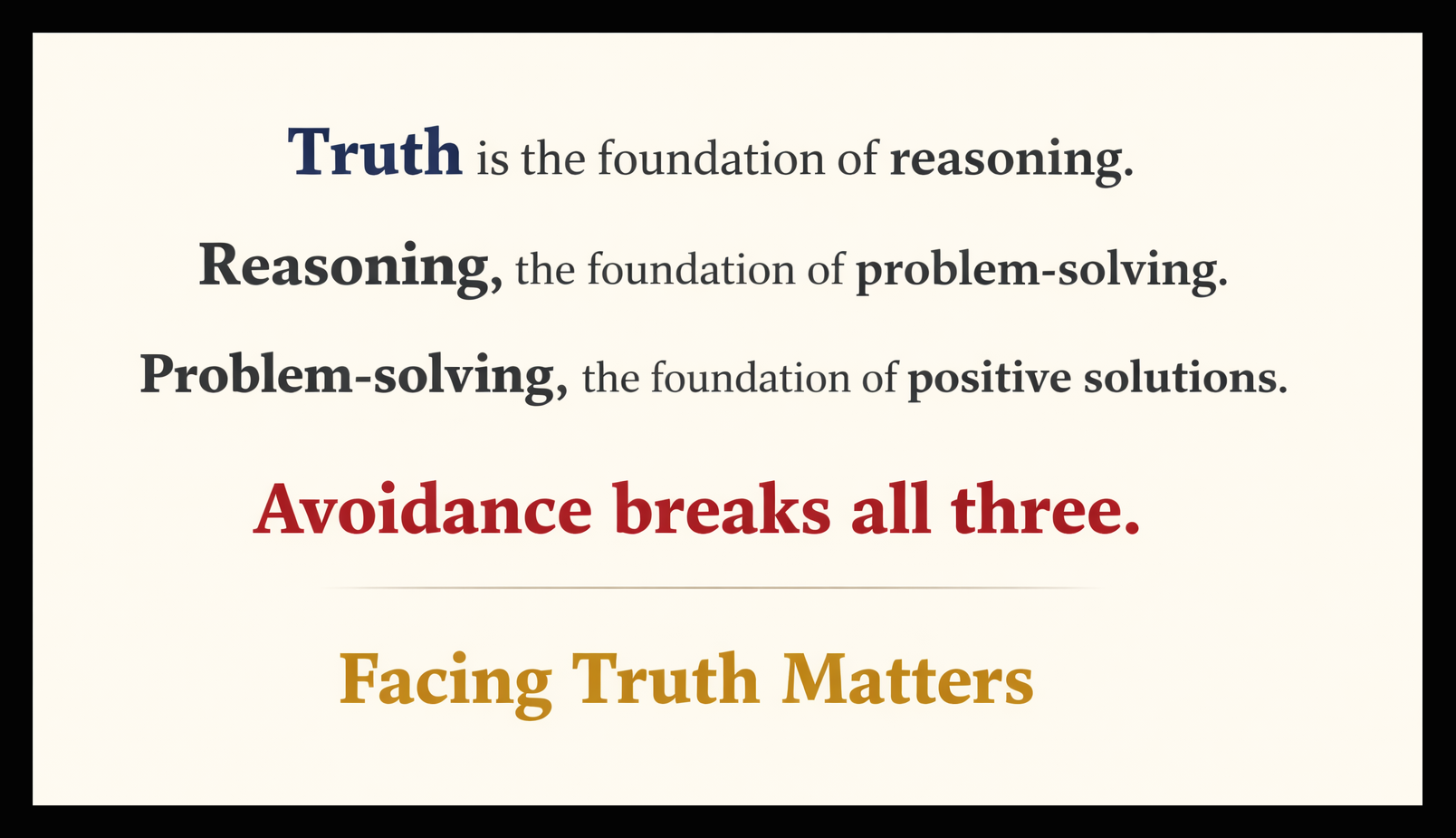
Truth → Reasoning → Problem-solving → Positive solutions
What matters is not how quickly solutions are found but how effective they are.
Across disciplines, the same pattern appears:
Avoiding emotions = avoiding pain. Avoiding truth = avoiding the emotions truth would trigger.
This is why your line is so accurate:
“Avoiding emotions is avoiding emotional pain. Avoiding truth is the same.”
Fear narrows human attention to a single point, creating a lifetime pattern where one priority becomes over magnified and everything else disappears. This attentional collapse is not a memory problem but a conditioned response formed in childhood and reinforced through pressure, evaluation, and survival-based thinking. Positive solutions require teaching people how to expand attention, reduce fear-driven narrowing, and maintain awareness of multiple important domains at once. When attention expands, reasoning expands, relational thinking expands, and responsibility expands.
When money becomes the primary focus, attention collapses into survival mode (Maslow's deficiency needs). Everything else: relationships, environment, community, long-term well-being, wildlife, population, pollution, falls out of awareness. This is the same mechanism as fear-driven memory collapse: the spotlight narrows to one object and all other priorities disappear. Positive solutions require shifting society from survival-based attention to well-being-based, higher maturity level of attention. People must learn to hold financial responsibility without losing sight of the larger systems that support life.
Education is the long-term foundation of positive change. It must teach people how to think, not what to think. This includes mindful reasoning, systems thinking, relational science, emotional regulation, environmental awareness, and the ability to hold multiple priorities without collapsing into fear-driven singular focus. Education is the antidote to attentional dominance. It builds minds capable of clarity, cooperation, responsibility, and long-term thinking.
Responsibility is the bridge between awareness and action. People cannot act responsibly toward what they do not notice. When attention collapses, responsibility collapses. When attention expands, responsibility expands. Responsibility must be taught as a relational act: responsibility to people, to community, to the environment, and to future generations. Positive solutions require restoring responsibility as a shared, collective, and conscious practice.
Groups amplify whatever attention pattern individuals bring. Fear-driven individuals create fear-driven groups. Narrow-focus individuals create narrow-focus societies. But expanded, responsible individuals create cooperative, stable, and positive groups. Research shows that when 25% of a group adopts positive reasoning, the entire group shifts. This critical mass is the tipping point for societal change. Positive solutions require building groups that reinforce expanded attention, positive reasoning, environmental responsibility, and relational thinking.A focus on expanding positive groups seeking positive solutions is critical to the development of positive reasoning and positive outcomes. When enough people model constructive reasoning, cooperation becomes self reinforcing, and the group begins to think and act as one coherent, positive system. Research on social tipping points shows that when roughly 25% of a population consistently demonstrates a new behavior or belief, it becomes the critical mass that shifts the majority.
In other words, one quarter of people reasoning positively can change the direction of the whole.
Positive leadership is imperative. It is the stabilizing force that aligns groups, communities, and nations toward truth, cooperation, and long‑term well‑being. Positive leaders do not protect identity, ego, or short‑term gain; they protect people and the Earth. They model calm reasoning, emotional maturity, and responsibility, preventing the collapse of attention into fear, bias, or groupthink. When leaders prioritize truth, shared goals, and ecological awareness, they elevate the reasoning of the entire group, promote copperation and teamwork. Positive leadership is the first societal safeguard against emotional reasoning, and the foundation for restoration, stewardship, and sustainable progress.
Positive solutions begin with understanding harm clearly and managing healthy, constructive responses. Problems escalate when harm is misinterpreted:
Awareness is the first step toward kindness, responsibility, healing, and community safety, but awareness alone cannot fix systemic errors. First responders often have only two responses, ignore or punish, failing in situations that require reasoning, mediation, and health‑focused intervention to turn a negative into a positive solution.
Importantly, the energy, time, and cost of dealing with the consequences of opposition after harm occurs is far greater than the cost of employing people who can address concerns early. A healthy system needs a referral pathway to social workers, psychologists, conflict‑resolution experts, and community health responders who can identify root causes, de‑escalate conflict, and transform harm into positive, responsible outcomes.
When individuals shift from emotional reasoning to calm, positive reasoning, the same skills scale to families, communities, nations, and environmental decisions.
Positive reasoning strengthens cooperation, reduces conflict, and improves decision making across every human system.
Positive reasoning expands awareness beyond self, restoring connection to people, communities, wildlife, ecosystems, and future generations.
Positive reasoning interrupts fear, bias, and groupthink, allowing societies to choose wiser, more cooperative paths instead of escalating conflict.

Positive reasoning replaces short‑term extraction with long‑term stewardship, protecting biodiversity, land, water, and the stability of future life. We have already shown that when fear, money, or identity dominate, human attention collapses. This collapse makes people stop seeing the land as a shared living system and begin treating it as a possession. The same emotional reasoning that narrows concern to “me, my comfort, my money, my group” also narrows environmental awareness, causing people to overlook ecosystems, wildlife, biodiversity, and long‑term consequences. This attentional collapse is the psychological engine behind overdevelopment, land privatization, and the disappearance of natural beauty, including the landscapes that define Montana. When natural beauty is replaced by buildings, isn't something essential to the human spirit also lost? Look at picture above again
Bison restoration is a clear example of positive environmental reasoning. For thousands of years, bison shaped the prairie ecosystem, supported biodiversity, and created the iconic landscapes that people still travel to see. The photograph of bison standing in front of Square Butte is not just history, it is a reminder of what Montana’s land once looked like, and what it could look like again. Bison are not only wildlife; they are ecological engineers whose presence restores grasslands, soil health, water retention, and habitat for countless species.
Positive solutions require making restoration economically possible. When the federal government restricts shared land access for conservation herds, such as the recent removal of grazing permits from American Prairie, it reinforces the attention collapse that treats land as a possession rather than a shared ecological system. Positive reasoning suggests the opposite approach:
• subsidizing bison the way cattle are subsidized • lowering the price of bison meat to encourage ranchers to adopt bison • restoring shared federal land access for conservation herds • supporting community‑based bison cooperatives • recognizing bison as a public ecological asset, not a private threatWhen bison become economically viable, restoration becomes possible. Lowering the price of bison meat, supporting processing infrastructure, and sharing federal land with conservation herds would allow ranchers, communities, and businesses to benefit from the ecological and economic value of bison. In Great Falls, the return of bison to the prairie, especially in front of landmarks like Square Butte, would become one of the region’s strongest attractions, strengthening tourism, identity, and community pride.
Positive environmental solutions align economic incentives with ecological truth. When people see that restoration brings long‑term prosperity, cooperation becomes easier. When land is treated as a shared living system rather than a possession, stewardship becomes possible. When attention expands beyond short‑term profit, communities can protect the beauty and biodiversity that future generations depend on.
Positive reasoning increases empathy and responsibility, widening the circle of concern from “me and my group” to “all people and the Earth.” The foundation of this website is built on the principle that expanding conscientiousness, rather than remaining trapped in negative bias or emotional reasoning is the healthier, more hopeful, and more responsible path for humanity. Negative reasoning offers no benefit; it narrows awareness, collapses responsibility, and disconnects people from one another and from the Earth. Positive reasoning restores connection, expands awareness, and strengthens the shared stewardship needed for human well‑being, environmental protection, and the future of life on this planet. It also helps people to be happier. The U.N. happiness report demonstrated a decline in the U.S. position from 11th place to 23rd place over 15 years.
Positive reasoning requires intentionally shifting attention away from negative bias and toward constructive action. Opposition is sometimes necessary, but it cannot be the center of our lives. A healthy society spends a meaningful portion of its time creating solutions that serve all people and the Earth. This intentional shift from reacting to problems to generating positive outcomes is the foundation of responsible maturity and long‑term well‑being
Rationale: Positive psychology, organizational development, conflict‑resolution science, and the book’s Threat Loop model all show that opposition drains resources while constructive direction restores them. When opposition exceeds ~40%, systems become reactive and negative‑bias dominates.
Relational Science is the understanding that human life is shaped by our relationships with everything on the planet, with people, communities, land, wildlife, and the systems that support life. Positive reasoning aligns human behavior with this reality, strengthening interdependence, ecological awareness, and shared well‑being. This principle is foundational to the purpose of this website: healthy relationships require expanded conscientiousness, empathy, and responsibility, not negative bias or emotional reasoning. When people reason positively, they relate to others and to the Earth with greater care, clarity, and stewardship, creating conditions where both humanity and the planet can thrive.
Positive reasoning supports restoration over depletion, healing ecosystems, rebuilding community trust, and repairing the human–earth relationship.
Positive reasoning improves attention and clarity, helping individuals and societies focus on what truly matters rather than money, fear, or identity protection.
Positive reasoning creates lasting, effective solutions that benefit people, communities, nations, wildlife, and the planet, the wiser path forward.
Positive reasoning strengthens democratic, community, and ecological decision making by grounding choices in truth, responsibility, and long term outcomes.
Positive reasoning restores interbeing, the awareness that human well being and Earth’s well being are inseparable.
A healthy and equitable society depends on how wealth is distributed and how widely its benefits are shared. When resources and decision making power are concentrated in the hands of very few, communities often lose their voice, and solutions tend to reflect narrow interests rather than the collective good. Positive solutions encourage models where wealth supports broad participation, transparency, and long term societal well being.
Positive stewardship means:
Many of the most beautiful places on Earth are places people naturally want to build homes, resorts, and businesses, which are also the regions with the highest biodiversity. These landscapes support pollinators, wildlife, clean water, soil health, and climate stability. When development replaces these ecosystems, the planet loses irreplaceable biological strength.
Positive solutions focus on protecting and restoring these biodiverse regions as essential components of planetary health.
Positive land stewardship includes:
This approach protects the Earth’s healthiest natural systems, preserves beauty for future generations, and strengthens the ecological foundation that supports all life.
Reasoning itself is neutral. It only becomes distorted when politics, religion, identity, or emotion override clarity. Ideas, programs, philosophies, and education work best when they are grounded in evidence and in what benefits all people and the environment, not just me, my belief, or bias.
Communities often hyperfocus on expansion, more people, more buildings, more land converted pursuing the same myth that money buys happiness while overlooking the larger systems that create long-term prosperity. Real progress comes from increasing value rather than volume. Great Falls can raise income without damaging the environment by developing businesses that earn more because the landscape stays intact: river-based recreation, wildlife tourism, native plant nurseries, regenerative agriculture, and restoration companies that improve land rather than replace it.
Three of the five pillars of human happiness, positive emotion, meaning, and connection are directly supported by nature. Natural environments reliably produce awe, calm, fascination, joy, and restoration, which is why people feel better near rivers, open landscapes reduce stress, and wildlife sightings create excitement. Nature also provides cultural meaning and identity: the bison, America’s national mammal, symbolizes resilience, freedom, and ecological heritage, while Square Butte in Charlie Russell’s paintings anchors Great Falls to the landscape Lewis and Clark described. These symbols are not decorative; they are emotional and cultural touchstones that give people a sense of belonging to place. Research shows that most people who come to Great Falls are drawn by nature, because the Missouri River, the falls, the prairie, the wildlife, and the sky satisfy the deeper foundations of well‑being.
Income rise when the city redevelops unused commercial space, converts aging buildings into mixed-use hubs, and concentrates growth within the existing footprint instead of pushing outward toward the Sun River corridor. Modern communities don’t need more physical structure to provide more services; they need better coordination. Artificial intelligence can centralize planning across transportation, utilities, emergency services, business development, and environmental protection, allowing a city to deliver more with less. By mapping resource use, optimizing traffic flow, streamlining permitting, monitoring wildlife corridors, and coordinating public services, AI can reduce the need for new roads, new buildings, and new administrative layers.
As coordination improves, some people fear that artificial intelligence will eliminate jobs. In reality, AI shifts work rather than removing it. When routine administrative tasks are automated, communities can use AI and invest in cross‑training workers into higher‑value roles: environmental monitoring, restoration projects, community planning, emergency support, public health coordination, and technology-assisted fieldwork. Cross‑training strengthens job security by expanding each worker’s skill set, making the workforce more adaptable, more resilient, and more capable of supporting the city’s long-term prosperity. AI does not replace people; it elevates them into roles that matter more.
The Montana I‑15 / Missouri River corridor demonstrates how whole-system thinking can restore prosperity without expansion. Water naturally spreads across soil, grasslands, riparian zones, beaver ponds, and shallow aquifers, absorbing into root zones and subsurface flows before slowly returning to the Missouri through seepage, springs, and creeks. Unlike Lake Mead’s massive evaporation losses in a sandstone basin, evaporation here stays in Montana’s atmosphere, feeding local humidity carried eastward by the powerful 400‑mile wind corridor along the Rockies. This creates a moisture engine rather than a drainage chute.
Restoring naturalized distributary channels,shallow, meandering waterways that slow and spread water can stitch the corridor back together. This supports beaver-driven wet meadows, bison-supported prairie mosaics, and long-term groundwater recharge while increasing ecological resilience and scenic value. This approach mirrors the successful hydrologic restoration at the South Slough National Estuarine Research Reserve in Coos Bay, Oregon, where reconnecting water pathways revived entire landscapes. With similar methods and rancher incentive programs already used across the West, Montana’s corridor can become a self-sustaining system that retains water longer, strengthens regional climate, supports wildlife, and expands tourism between Yellowstone and Glacier.
New Jersey and New York illustrate the opposite pattern. Large areas once covered by forests, farms, wetlands, and open fields were originally settled because people valued the beauty and abundance of the natural environment. But as the built footprint expanded, those same landscapes were converted into highways, malls, industrial parks, and dense housing developments. Governments had to fund more roads, schools, sewers, police, and emergency services, pushing taxes upward to support the growing infrastructure and administrative load, all while destroying the very land that had drawn people there in the first place. Traffic congestion, air pollution, noise, and stormwater runoff increased, degrading rivers, coastal areas, and wildlife habitat. Land that had once been freely enjoyed as open space became fragmented into private parcels, fenced off, posted, or paved, making the landscape feel less accessible and less inviting. Covering land with buildings and ownership did not create beauty; it erased the qualities that once made those places feel open, healthy, and alive. This pattern demonstrates why natural environments must be preserved: once they are lost, the pillars of well‑being they support disappear with them.
In contrast, if bison roamed restored wetlands in front of Square Butte, tourism would expand from Yellowstone to Glacier. Ecological restoration would generate prosperity without sacrificing the land that makes Montana unique. A community that restores its land, coordinates its systems, and reduces negative bias becomes a place where prosperity and happiness rise together, not through expansion, but through well‑being.
The mindful practice of identifying fallacies, distortions, and reasoning errors in communication without hostility or escalation.
Categories: Reasoning • Relational Science • Responsibility & Personal Growth • Group Dynamics
(Cross‑Category Skill)
Its purpose is clarity, fairness, and truth.
Every Mindful Solution in this book rests on one foundation: clear, accurate communication. We cannot reason well if the message is distorted. We cannot grow personally if we misinterpret or fear what is said. We cannot maintain healthy relationships if we react to assumptions instead of the truth. And no group, community, or nation can stay stable when communication is driven by emotion, bias, or unchecked fallacies. That is why Constructive Error Recognition stands as the final solution because it protects every solution that came before it. When we learn to examine claims, evidence, logic, emotion, and distortion with calm precision, we stop solving imaginary problems and start addressing real ones. Mindfulness becomes functional. Responsibility becomes grounded. Relationships become clearer. Groups become healthier. And solutions become truthful. Communication analysis is not an accessory to mindful living; it is the gateway. Without it, every solution is vulnerable. With it, every solution becomes possible.
This method transforms communication from reactive to accurate, emotional to clear, and divisive to restorative. It is one of the most essential tools for healthy reasoning, strong relationships, personal growth, and stable group dynamics.
The purpose of this website is to lay a foundation for understanding human behavior, including negative bias, reactive patterns, and communication habits, so that we can understand the importance of taking time for reflection to develop positive, mindful solutions that serve the best interests of all people and the Earth. Prior to reaching that level it often helps to reflect and learn to recognizw our own behavioral patterns, reactions, assumptions, and the ways we communicate. We welcome mindful suggestions that are constructive, respectful, and supportive of the well‑being of all people and the planet we share.