
Healthy kelp forest
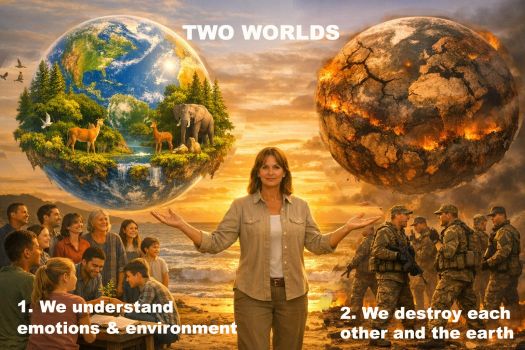
What is your Choice?
Two Worlds There are two fundamental understandings of humans and nature, both essential for anyone who wishes to live in a peaceful, healthy, and beautiful environment. To stay in balance, people must fully understand both:
Education must also address the root causes and costs of opposition. Most conflict, whether in families, communities, or nations arises from unregulated emotions, misinterpreted intentions, reactive thinking, and limited understanding of how groups behave under stress. These misunderstandings create predictable patterns of fear, rivalry, and escalation that drain large amounts of time, energy, and resources. Globally, opposition contributes to trillions of dollars in losses each year through conflict, polarization, misinformation, and resistance to solutions, while delaying cooperation that could restore ecosystems, strengthen communities, and improve human wellbeing. When people gain a basic awareness of how emotions, relationships, and ecological systems function, they are more likely to choose cooperative strategies rather than systems that concentrate power and resources in the hands of a few. Education reduces the cost of opposition by teaching how emotions work, how relationships function, how groups behave, and how actions create consequences, allowing societies to move forward together.
Healthy learning grows from curiosity, safety, and clear guidance. When children and adults learn in supportive environments, they develop the emotional skills, confidence, and awareness needed to contribute positively to their communities and the world. However, many parents grew up in reactive, unstable, or fear‑based environments themselves. Research shows that adverse childhood experiences in parents are strongly associated with negative emotional and relational patterns in their children. Without recognizing the need for emotional regulation, something many people are afraid to face, and without learning reflection and positive relational habits, parents cannot teach these skills to their children, because most were never taught these tools themselves. This lack of emotional regulation scales from families to communities and nations; the same reactive patterns that create interpersonal conflict also appear in national decision‑making. The evidence lies in the recurring tendency of societies to return to war as a solution rather than investing in the emotional skills, diplomacy, and cooperative problem‑solving required to prevent escalation.
These patterns repeat across generations unless individuals develop awareness, learn to reflect, and intentionally change the behaviors they inherited. Research shows that parents’ everyday psychological distress and the emotional climate of the home predict similar distress patterns in their children, and this transmission occurs through the family’s emotional environment. This means the common belief that children learn emotional skills solely from their parents is incomplete; they learn from the entire emotional system surrounding them.
Human societies have long depended on cooperation for survival. Tribal communities required coordinated effort for security, protection, food, and stability. Early American communities also relied on mutual support, and this tradition of people helping people shaped the idea of “for the people, by the people.” As society expanded, public programs such as Social Security, Medicare, Medicaid, and worker protections were created as national versions of this same cooperative principle.
Over time, some groups labeled these programs as socialism, not because they were socialistic, but because they preferred private, profit‑based systems. The belief that government is always wasteful and private systems are always better became a persuasive narrative, even though it was not supported by universal evidence. This shift in messaging, combined with the financial incentives of privatization, moved society away from mutual support and toward systems that often benefited the wealthy, contributing to greater dissatisfaction among ordinary people.
Across historical, psychological, and ecological evidence, one conclusion is consistent: teamwork produces better outcomes than opposition. Cooperative systems reduce friction, increase shared problem‑solving capacity, and align resources toward solutions rather than conflict. Education that teaches these mechanisms clearly can help societies rebuild mutual support and move forward together.
Most people assume education is primarily about four areas:
These assumptions are widespread, but they overlook two essential areas of human development that promote a happier, more peaceful world: emotional understanding and ecological understanding. Without emotional understanding, human relationships destabilize, societies fracture, and peace is lost. Without ecological understanding, ecosystems collapse and species, including humans, face increasing risk of decline or extinction. These two forms of understanding are not optional; they are the foundations that keep both humanity and the natural world alive, stable, and capable of supporting future generations.
Without learning how emotions work, how relationships function, how groups behave, and how ecological systems support life, individuals and societies struggle to prevent conflict, cooperate effectively, or make decisions that protect long‑term wellbeing. Modern challenges, from interpersonal conflict to environmental degradation show that academic knowledge alone is not enough; people also need the emotional and ecological skills that allow communities and nations to function peacefully and sustainably.
While most people presume that education is mainly about securing a higher‑paying job and improving personal quality of life, this narrow view overlooks the deeper purpose of learning. Many do not see emotional development as part of education, even though the most costly problems in society; opposition, delinquency, gangs, mob behavior, riots, extremism, pollution, and war, arise from unregulated emotions, reactive thinking, and the absence of relational and environmental understanding.
At some point in their education, children must learn the emotional and cognitive skills their parents were never taught: emotional regulation, healthy communication, responsibility, clear thinking instead of reactive thinking, and the ability to develop genuine focus, positive values, and happiness. The same principle applies to the environment. And even if some of these ideas are introduced in school, they are not reflected in the way society currently behaves. Children need to learn relational science, how all systems are interconnected, how human wellbeing depends on ecological wellbeing, and how destructive behaviors toward each other and the environment ultimately harm both people and the planet. Education must teach not only academic knowledge but also how systems work together, how actions create consequences, and how interdependence shapes every part of life.
Considering that the world spends as much as $19 trillion each year on conflict, David Beasley, Executive Director of the World Food Programme, noted that ending hunger by 2030 would cost about $40 billion per year, an amount dramatically smaller than the cost of global opposition. This comparison illustrates a central point: humanity could solve many of its most persistent problems if it understood the cost of opposition and how to reduce it. The more time, energy, and money societies spend in conflict, the less they have available for improving relationships, restoring ecosystems, and helping people rise above the struggle of life to reach higher levels of wellbeing and self‑actualization.
To learn all of the material covered in this book and the deeper details behind it, normally requires several separate college disciplines: psychology, sociology, communication, environmental science, ethics, and systems theory. Most educators were never trained in this full interdisciplinary framework, not because of any limitation on their part, but because traditional education was never designed to integrate these fields. AI, however, can teach them as a unified whole. Because AI can connect concepts across disciplines, personalize instruction, and identify gaps instantly, a motivated student could learn the core of this interdisciplinary framework in a single semester. AI is the first tool capable of teaching the emotional, relational, cognitive, and ecological skills that traditional education has never been structured to deliver.
The top images show the core principle shared by both nature and human systems: cooperation creates stability. In the kelp forest, every organism moves in coordinated balance, predators, prey, sunlight, and growth all align to create a single functioning healthy balanced system. On the human side, cooperation mirrors that same natural order: people organizing, communicating, and synchronizing their roles so ideas, effort, and progress flow in one direction. Both scenes reveal the same truth. When all aspects of coordination come together, healthy systems thrive.

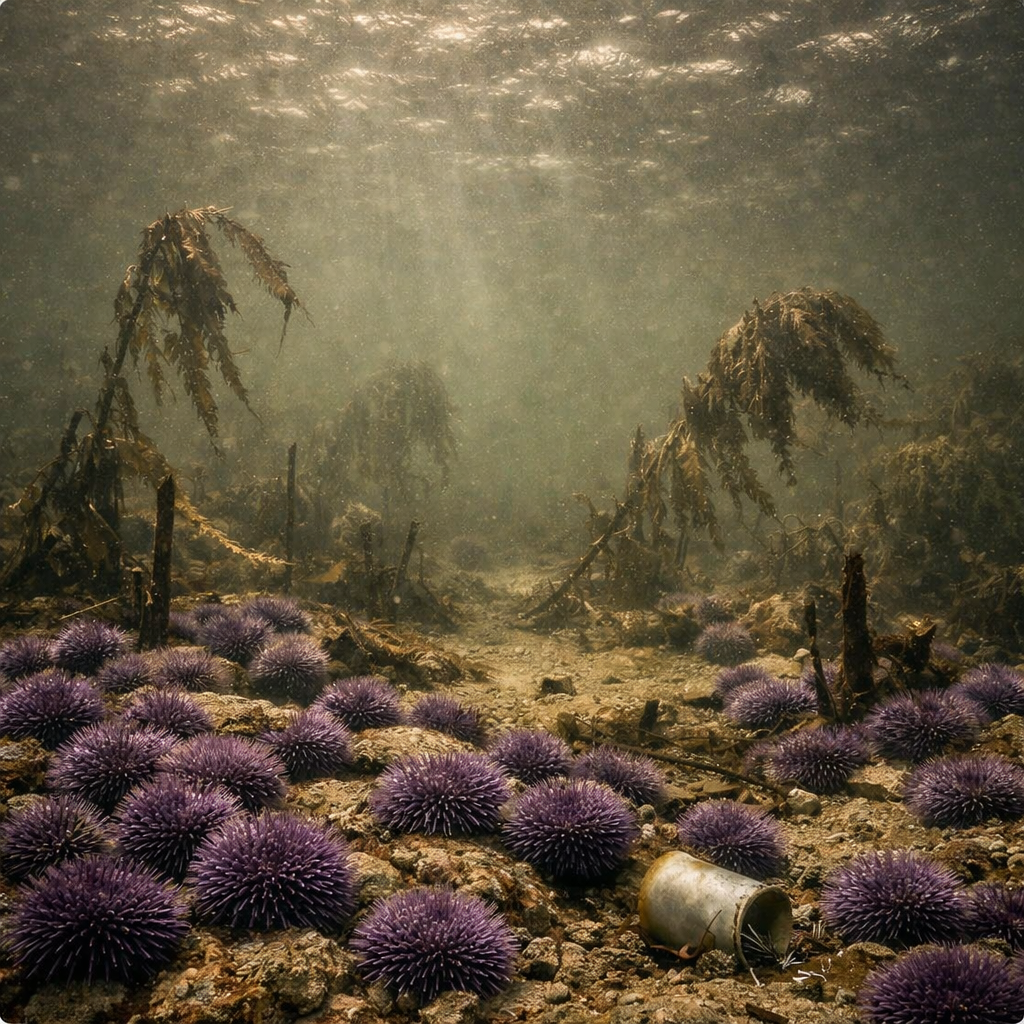
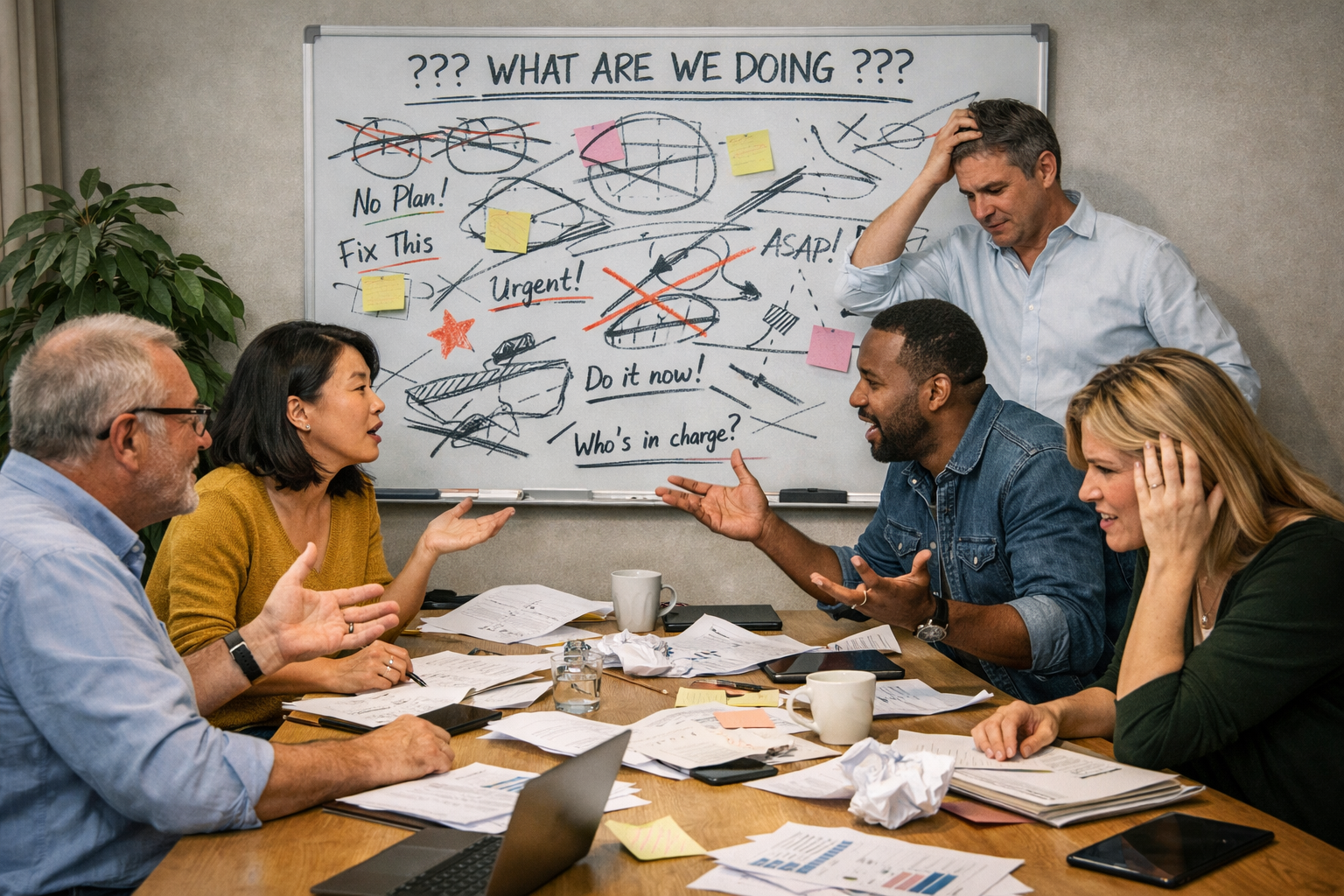
The lower images show what happens when the stabilizing forces in a system disappear. In nature, removing a keystone species(otters) unravels the entire balance, predators vanish, grazers (urchins) explode, kelp forests collapse, and chaos spreads throughout every layer of the ecosystem. In human systems, removing respect, clear communication, truth, and emotional regulation creates the same breakdown: miscommunication grows, distrust spreads, propaganda replaces understanding, and groups spiral into confusion, conflict, and disorganization. When the forces that hold systems together are removed, both nature and human communities fall into predictable patterns of collapse.
Understanding the Balance of Human Limits and Earth’s Limits Both nature and humanity depend on keystone elements, critical stabilizing forces that hold entire systems together. When these essential components are removed, whether the species that maintain ecological balance or the human qualities that stabilize relationships such as respect, communication, cooperation, and truth, the system begins to break down. Removing components that holds a system together leads to predictable collapse.
Understanding Systems Balance (Human and Earth Relational Science) Specific keystone examples show the pattern clearly. In nature, when sea otters disappear, sea urchins explode in number and destroy entire kelp forests, ecosystems capable of absorbing between 2 and 20 times more CO₂ per acre than most terrestrial forests and producing oxygen at levels comparable to tropical rainforests. When wolves are removed, grazing animals overrun valleys and destabilize rivers. When coral reefs die, fish populations collapse. When wildebeest decline, grasslands overgrow and burn. And when bass are removed from rivers, insects and algae overrun the system and water quality collapses. Everything is connected to everything else.
Human systems follow the same relational rules. When emotional regulation is missing, one person’s impulsive reactions can spread through a family or workplace until trust and stability collapse, just like urchins overrunning a kelp forest when otters are gone. When social boundaries disappear, dominant individuals or groups take more than their share, draining resources and destabilizing institutions, the human version of grazers stripping a valley bare. When trust is damaged, the relational “reef” that supports life breaks down and people withdraw or form defensive factions, just as fish vanish when coral dies. When conflict‑resolution skills are absent, resentment builds up like dry grass until a small spark ignites a destructive social wildfire. And when accountability is removed, harmful behaviors multiply and create a toxic environment, just as algae blooms overwhelm a river when predators are gone.
Ecological Limits Humans fall out of balance with nature because they misunderstand both the limits of the Earth and the limits within themselves, and because they misunderstand the interdependence that connects all living systems. Ecological limits are clear: forests cannot regrow faster than they are cut, oceans cannot absorb endless pollution, species cannot survive when their habitats collapse, and climate systems cannot stabilize once pushed beyond their thresholds. Yet humans often behave as if these limits do not apply, believing that resources are infinite, that growth can continue without consequence, and that nature will absorb whatever we take or discard.
Human Limits Humans also have limits that cannot be ignored. People cannot tolerate constant disrespect, miscommunication, manipulation, or environments filled with fear and instability. Human relationships cannot survive without trust, honesty, emotional regulation, and cooperation. Communities cannot function when propaganda replaces truth, when conflict replaces dialogue, or when individuals are pushed beyond their emotional and cognitive capacity. Just as ecosystems collapse when their keystone species are removed, human systems collapse when their keystone relational components are removed. Negative bias and opposition are among the most destructive forces, breaking down the very elements required for stability and cooperation.
Emotional and Social Limits Humans also ignore emotional and social limits. People push past their own capacity for stress, react impulsively without understanding their emotions, misread the intentions of others, and escalate conflict instead of resolving it. Groups fall into fear, rivalry, and dominance when emotional regulation is missing. These breakdowns mirror ecological collapse: when one force overwhelms the system, balance disappears.
Education and Restoration Both nature and human societies collapse for the same reason: when limits, relationships, and feedback loops are ignored, imbalance becomes inevitable. Education restores this understanding by teaching emotional regulation, boundaries, empathy, cooperation, biodiversity, and Earth’s natural limits so people can live in balance with each other and with the planet. When individuals understand how both human relationships and natural systems actually work, they gain the capacity to make choices that support stability, well‑being, and the long‑term health of the planet.
If we are not intentionally working to maintain the essential stabilizing elements of both nature and human relationships, we inevitably become part of the problem. Systems do not stay balanced on their own; they require active care, respect for limits, and conscious cooperation. When people ignore these responsibilities, imbalance grows, collapse accelerates, and both ecological and social systems begin to fail.
Positive Education:
The purpose of this website is to lay a foundation for understanding human behavior, including negative bias, reactive patterns, and communication habits, so that we can understand the importance of taking time for reflection to develop positive, mindful solutions that serve the best interests of all people and the Earth. Prior to reaching that level it often helps to reflect and learn to recognizw our own behavioral patterns, reactions, assumptions, and the ways we communicate. We welcome mindful suggestions that are constructive, respectful, and supportive of the well‑being of all people and the planet we share.