← Return to Main Website
← Back to Chapters
Individual Growth

Our development, shaped by the people and environments around us, formed the patterns we carry into adulthood.
The people who raised us, the environments we grew up in, and the beliefs and
behaviors modeled for us all influenced the relational patterns we carry into
adulthood, including how we see other people, groups, parties, religions, and
anyone different from us. These early influences shaped our worldview, the people
we associate with, and the habits of attention that determine not only what we notice,
but also what we ignore or don’t care about. Relational science
addresses our personal relationships as well as the relationship of everything to everything else.
Most of us move through life focused on what we wanted to achieve, without
much awareness of how our actions affect other people, the environment, or
those who come after us. From birth through much of early adulthood, many of us
spend years struggling just to meet our basic needs. Research on happiness shows
that until those needs are met, it’s hard to think beyond ourselves to reflect
and give thought to how we fit into the schema of life. Because of this, many people don’t reach the maturity level
or perspective Maslow called self actualization until mid‑life, if at all.
Key Focal Points:
Development
Reasoning
Reasoning for all of us developed in stages: children begin with emotional,
intuitive thinking. The foundation of early learning is based on a primal
need to react emotionally to get our needs met. Children cannot regulate emotion
alone. They borrow and model parental nervous system behaviors. By age five, most of
our personality is already shaped by these habitual emotional patterns, influenced by
everyone around us. That emotional being becomes the emotional foundation of
our reasoning. Parents, if attuned, help stabilize this stage by responding
appropriately to the child’s emotional expressions and needs. Around age seven we gain
concrete logic, and in adolescence we develop abstract, long‑term reasoning
as the prefrontal cortex and executive function mature, a process that does
not fully complete until roughly age 25–30. When early emotional learning is
unstable or later reasoning stages don’t fully develop, the system collapses
into reactive behavior instead of intentional positive thought. This developmental
mismatch is extremely common; most adults carry some degree of early emotional
wiring that continues to shape their reactions long before reasoning developed.
Relational Science
Our relationship to other people and the environment develops the same way
reasoning does. It begins emotionally, becomes concrete around age seven,
and only becomes intentional and reciprocal in adolescence and adulthood.
Early on, children understand others and the world through emotion and
immediate needs; by seven they can take perspective and understand fairness;
and as the prefrontal cortex matures with reasoning, they gain the ability
to form stable, responsible, long‑term relationships, but only if the
foundation of
relational learning
is positive, healthy, and stable. The focus of attention in development
shapes what we notice, care about, ignore, or remain oblivious to. And because
stable, attuned relational foundations are uncommon, most adults enter life
missing essential components of health relational development that shape how they connect, respond,
and relate to everything around them. When early relational learning is
inconsistent or insecure, later relationships become reactive, avoidant, or
exploitative instead of connected and responsible. This includes how we relate to other people, wildlife, and the
Earth itself.
Communication
Communication develops in the same staged manner as reasoning, but may
vary considerably between individuals. Early communication is emotional and
nonverbal, because children rely on feelings, gestures, and sensory cues
long before they have sophisticated language. Our emotional language, the pragmatics of
tone, expression, intention, and relational signals, forms first and
becomes the foundation of how we communicate throughout life. There is a
great deal of sophistication involved in speech and language development
that most of us take for granted. Around age seven, communication becomes
more concrete and logical, and in adolescence it becomes intentional,
reciprocal, and capable of nuance as reasoning and the prefrontal cortex
mature. When early communication learning is inconsistent or emotionally
unstable, later communication becomes reactive, defensive, or avoidant
rather than clear, responsible, and connected. This becomes a significant
factor shaping our
relational science
with everything else.
From birth to age five, the brain learns almost entirely through emotion rather
than logic. During this period, the child cannot regulate emotions alone and instead
follows and imitates the emotional patterns modeled by parents, caregivers, peers,
and the surrounding environment. Any repeated emotional experience, whether positive
or negative becomes ingrained in the nervous system as automatic wiring and automatic responses.
It is important to clarify that negative emotional learning does not come only
from parental conflict. It can come from peer rejection, bullying, harsh educational
environments, community instability, neighborhood violence, gangs, discrimination,
chronic stress, or even war and displacement. Any environment that repeatedly
activates fear, uncertainty, or emotional overwhelm teaches the child one core
lesson: emotions are dangerous, unpredictable, or shameful.
This is the root of the “fear of fear” and explains why many adults avoid emotional
topics altogether. If emotions were painful or unsafe in childhood, the adult
nervous system learns to avoid them, ignore them, or shut them down. This avoidance
becomes a habit, not a choice.
These early emotional habits become the default settings for attention,
interpretation, threat detection, relational expectations, and self‑protection.
Emotional logic becomes the first habit loop. When the amygdala fires quickly,
the brain forms emotional logic long before reasoning develops.
If the environment is stable, the habit loop becomes patience, listening, interpretation, and responding.
If the environment is unstable, the habit loop becomes reaction, defense, and escape amygdala‑driven behavior.
This is the origin of negative bias, overreaction, and DRRs (Disproportionate Recurring Reactions).
Repetition strengthens the nervous system in predictable ways:
repeated fear → fear habit
repeated calm → calm habit
repeated conflict → conflict habit
repeated avoidance → avoidance habit
repeated responsibility → responsibility habit
Habits are not moral qualities; they are neural efficiencies.
Adolescence can reinforce or distort these patterns because the brain is still
maturing into the mid‑20s. Hormones amplify emotional reactions, peer
pressure reinforces patterns, and reasoning is not fully developed while the
frontal lobes are still maturing. This is why adolescents often repeat early
patterns unless they are taught awareness and regulation.
By adulthood, most people are not consciously “choosing” their behavior. T
hey are mostly running the habits they inherited, learned, or repeated earlier
in life. They blame, act defensively, shut down, catastrophize, overreact, and
avoid in automatic ways. Trauma intensifies these patterns, with amygdala
reactivity producing fight, flight, or freeze as survival habits. PTSD is the
extreme version: the threat system becomes so sensitized that the brain misreads
the present through the lens of past danger.
Once a person recognizes the pattern, it becomes possible to use logic instead
of emotional reasoning and to seek evidence, facts, and truth. They can learn to
interrupt the old habit, choose a new response, repeat it, and build new habitual
patterns that are healthier and more appropriate.
True healing begins when a person can face emotional pain and the truth directly
without reacting out of fear. Healing is the process of learning to accept reality
while remaining open to reasoning, allowing truth to be considered without opposition.
This includes learning to tolerate the unpleasantness that comes with truth and
emotion so that clarity can replace avoidance. This active form of acceptance allows
a person to set boundaries, make responsible decisions, and act with integrity.
True healing does not mean accepting harmful circumstances or tolerating mistreatment;
it means facing reality with courage so that genuine stability, growth, and well‑being can take place.
Recognizing these patterns is only the beginning. Many of the habits formed in childhood;
avoidance, blame, defensiveness, shutting down, or escaping discomfort may have all been
part of a child’s survival needs for safety, self‑preservation, and the growing and
learning process of the developing self prior to maturity. These patterns made
sense in an environment where the child had limited power and limited reasoning. but in adulthood, they become
self-dulgent and counterproductive. They are no longer appropriate for oneself, the people
around them, or the larger environment we all depend on. These outdated habits must be
replaced with new patterns that reflect responsibility, truth, and the long term
best interests of people and the world we live in. Healthy, effective problem solving
must replace blame. Facing reality must replace avoidance. Responsible action must replace
escapism. When a person chooses responses that align with clarity, responsibility, and
shared well being, they begin building habits that support healthier relationships, communities, and the environment.
Self‑management develops in the same manner as mentioned above and may also
vary considerably between individuals. Early on,
children rely entirely on adults to regulate emotion, attention, and
behavior. As reasoning and communication mature, they begin to internalize
regulation, understand consequences, and make choices with increasing
independence. In adolescence and early adulthood, as the prefrontal cortex
and executive function mature, individuals gain the capacity for long‑term
thinking, accountability, and intentional action. Much of this depends on
emotional factors in development that either reinforce or discourage success.
Parental guidance, self‑esteem, education, sports, games, and all forms of
challenges help shape emotional confidence, communication skills, and
leadership qualities, but only if the earlier foundations of emotional
stability, communication, and relational learning are strong. When those
foundations are inconsistent or unstable, self‑management remains reactive
instead of intentional. Throughout the entire process, emotional development
plays a significant role in shaping self‑management and confidence.
Awareness
Awareness grows only when we question our lives, reflect honestly, and find
the courage to face ourselves and our past. Rising above natural negative bias,
the tendency to focus more on threats and problems requires emotional security
and having our basic needs met. When survival pressure eases, usually in midlife,
it is more common for people to have the time and space to think about
purpose, impact, and meaning. That’s often when the mind can open to a deeper awareness
and new possibilities.
Intention
Intention becomes real when we question our lives, reflect honestly, and
find the courage to face ourselves and our past. Without that inner work, we
operate on habit, bias, and survival. With it, we gain the clarity to choose
actions that are in the best interest of both people and the Earth.
Responsibility
From birth to age five, the brain learns almost entirely through emotion, not
logic. During these years, a child cannot regulate emotions alone, they learn and borrow
the parent’s modeled nervous system of logic. Whatever emotional patterns the environment
provides becomes the wiring for how the amygdala interprets the world:
safety, danger, connection, rejection, threat, or calm. These early emotional
habits form the foundation for all later reasoning.
When development is stable, the amygdala learns to pause, interpret context, and hand signals off to the
reasoning brain. When development is unstable through inconsistency, fear,
neglect, or early stress, the amygdala becomes conditioned to fire quickly
and interpret neutral events as threats. This same mechanism later appears
in adulthood as Disproportionate Reactive Responses (DRRs) such as
catastrophizing, overreacting, emotional flooding, or shutting down. Trauma at
any age can intensify this pattern. Early trauma shapes the original wiring;
trauma in adolescence or adulthood can override or destabilize it.
PTSD
reflects the extreme version:
the threat system becomes so sensitized that memory, perception, and reasoning are pulled
into survival mode, causing the brain to misread present situations through
the lens of past danger. Ownership of reactions means recognizing that the
emotional surge comes from one’s own internal history, early wiring, learned
patterns, or trauma, often not from the logic of the moment or another person’s
behavior. The work is not to fix the trigger or argue the logic, but to
understand the root of the emotional signal and reclaim control over
how one responds.
This is why blame often becomes a form of emotional reasoning: a fast escape from fear
rather than a calm logical assessment of the cause. When fear spikes, the body
defaults to primal survival responses, freezing, escaping, or fighting.
This is the “lizard brain” pattern, an evolutionary mechanism passed down
through generations. The amygdala fires in roughly 150 milliseconds, while the
reasoning brain can take several hundred milliseconds to respond. If the
emotional signal is strong enough, stress chemicals like cortisol and
adrenaline surge through the body and temporarily suppress
the frontal lobes, the regions
responsible for logic, planning, and calming the reaction.
Because the brain takes nearly 30 years to fully mature under
healthy conditions, the reasoning system is not fully developed in
childhood or adolescence. This is one reason why giving a teenager
access to lethal tools during a period of hormonal volatility and incomplete
emotional regulation can be dangerous. That concern is well documented in the
literature (1,
2, 3 ). Likewise, early development disrupted
by fear, instability, or trauma, emotional or physical can stunt the growth
of healthy reasoning and responsible self‑management resulting in emotionally
charged or reactive behavior.
Business
A mindful approach to living is not centered on making money or accumulating
material gains. Research consistently shows that happiness depends primarily on
having enough to pay the bills, meet basic needs, and have a little left over
for enjoyment. Beyond that point, increasing income does not increase happiness,
and extreme income concentrations, such as exorbitant CEO pay, are inconsistent
with respect for others and with the wellbeing of the broader community.
From this perspective, happiness and wellbeing matter more than wealth,
and the degree to which this is understood depends on one’s awareness of
others and of the environment.
Mindful Solutions is not opposed to business; it is opposed to harm and to
practices that damage people or the environment. The intent is not to create
opposition to opposition, but to encourage a shift away from negative bias and
toward solutions that support happiness, responsibility, and shared wellbeing.
Business is not exempt from responsibility. It must operate with the same mindful
awareness expected of individuals, contributing to shared wellbeing rather than
extracting from it. Mindful business practices honor clean air, water, and soil;
fair and responsible treatment of people; and a focus on what benefits the community
and the environment.
The mindful intent is to think creatively and responsibly, to support a healthy,
happy, and enjoyable lifestyle that is not detrimental to others or to the Earth.
When the mind is reoriented away from negative bias and toward the wellbeing of
people and the planet, there is no justifiable reason for opposition.
Opposition
Opposition is the single most expensive human behavior. The reactive threat loop
burns energy, time, and money while diverting attention away from healthy problem‑solving
leading to productive solutions. Opposition is not the same as disagreement. Disagreement is
a cognitive stance while opposition is a reactive state. When the body detects a threat,
social, emotional, or identity‑based sensations, it shifts into a defensive posture that
narrows perception and turns communication into protection rather than connection.
In this state, people interrupt, talk over others, argue to win, and resist information
that challenges their position. Oppositional behaviors originate in early‑learned patterns,
but in adulthood they fire as automatic threat responses, expressions of the reactive threat
loop rather than deliberate choices. Without the underlying reactivity, disagreement
remains calm, curious, and collaborative. With reactivity, it becomes oppositional,
automatic, escalating, and costly. A key factor to remember about opposition is that
its true antonym is not rule‑by‑one, but teamwork, the skill we all learned in kindergarten. See
(
Group Opposition
).
From Individual to Seed of Group Dynamics
People seek comfort, and as social beings they are shaped by the emotional
environments they grow accustomed to. Once someone adapts to a familiar emotional
climate, they naturally resist change and gravitate toward others who feel
familiar, people who think, react, and interpret the world in similar ways. This
comfort‑based clustering leads individuals to form like‑minded groups, not because
of logic, but because shared habits feel safe and predictable. These shared beliefs,
emotional patterns, identities, and interpretations create a sense of familiarity,
safety, and belonging that social psychologists call an
in‑group.
In‑groups often define themselves by what they oppose. Shared dislikes,
frustrations, and threat perceptions create the psychological out‑group, the
people they distrust, reject, or see as “the problem.” Research consistently
shows that when like‑minded groups gather, especially around negative bias,
their shared views intensify. The group becomes more extreme, more reactive,
and more certain of its opposition than any one individual would likely do alone.
This is the mechanism by which individual emotional patterns scale into
collective identity and group‑level opposition. It is this opposition that leads
to group polarization.
But polarization is very costly. One study reveals the the cost of opposition is
$19.1 trillion per year, the total global cost of conflict, violence, and the
systems built to oppose, resist, or counter others’ actions.
Choosing the mindful Path:
-
Awareness Path:
Change doesn't happen without first recognizing that something needs changing.
Opening up the mind to the possiblity of change is the first step
-
Intention Path:
Remember that New Years resolution that never happenned? For change to take
place, one must intend to make that change happen. Old habits are hard to break. So new
habits start with practice, everyday till intention becomes habit.
-
Choose the Mindful Path:
Change becomes possible the moment we choose a mindful path. In Buddhism,
mindfulness means living in the present without judgment, releasing the past
and loosening our grip on imagined futures. Letting go of negative bias and
replacing it with what is positive, healthy, and possible builds new patterns
over time. A simple daily check‑in strengthens this path: How well did I focus
on the positive today? And can I choose a path tomorrow that brings patience, peace, meaning, and happiness into my life?
-
One Clear Choice Over Hundreds of Fears:
One mindful choice is more powerful than the hundreds of fears, phobias, and
reactive patterns the mind can generate. Fear multiplies into endless variations,
but mindfulness is a single, stable path that cuts through all of them. Choosing
happiness, clarity, and presence replaces complexity with simplicity and shifts
life from fear‑based reactions to intentional living.
-
Choose Happiness / Positive Psychology:
Choosing happiness: Positive psychology suggests that building well‑being through
strengths, positive emotion, and intentional habits is a clear alternative to
the DSM’s catalog of fear‑based responses. Positive psychology focuses on
what helps people flourish, not what is wrong. It offers a practical,
evidence‑based path for cultivating well‑being through daily choices.
What Is Positive Psychology?
-
Business Oportunities
mindful business contributes to the well‑being of all people and the Earth
by operating with awareness, fairness, and responsibility. Its purpose is not
to maximize personal gain, but to support a healthy, enjoyable, and sustainable
life for individuals and communities. Mindful business seeks to enhance the
community and environment rather than oppose, extract from, or work against them.
When business practices honor clean air, clean water, healthy soil, and respectful
treatment of people, they strengthen happiness, reduce harm, and create shared value.
Mindful Solutions encourages business thinking that is creative, non‑adversarial,
and aligned with what benefits the whole, supporting collective well‑being and a
shift away from negative bias and unnecessary opposition.
Opposition in business arises when awareness is absent and creativity is limited.
When thinking is centered on people and the environment, business becomes a constructive
force rather than a source of conflict.
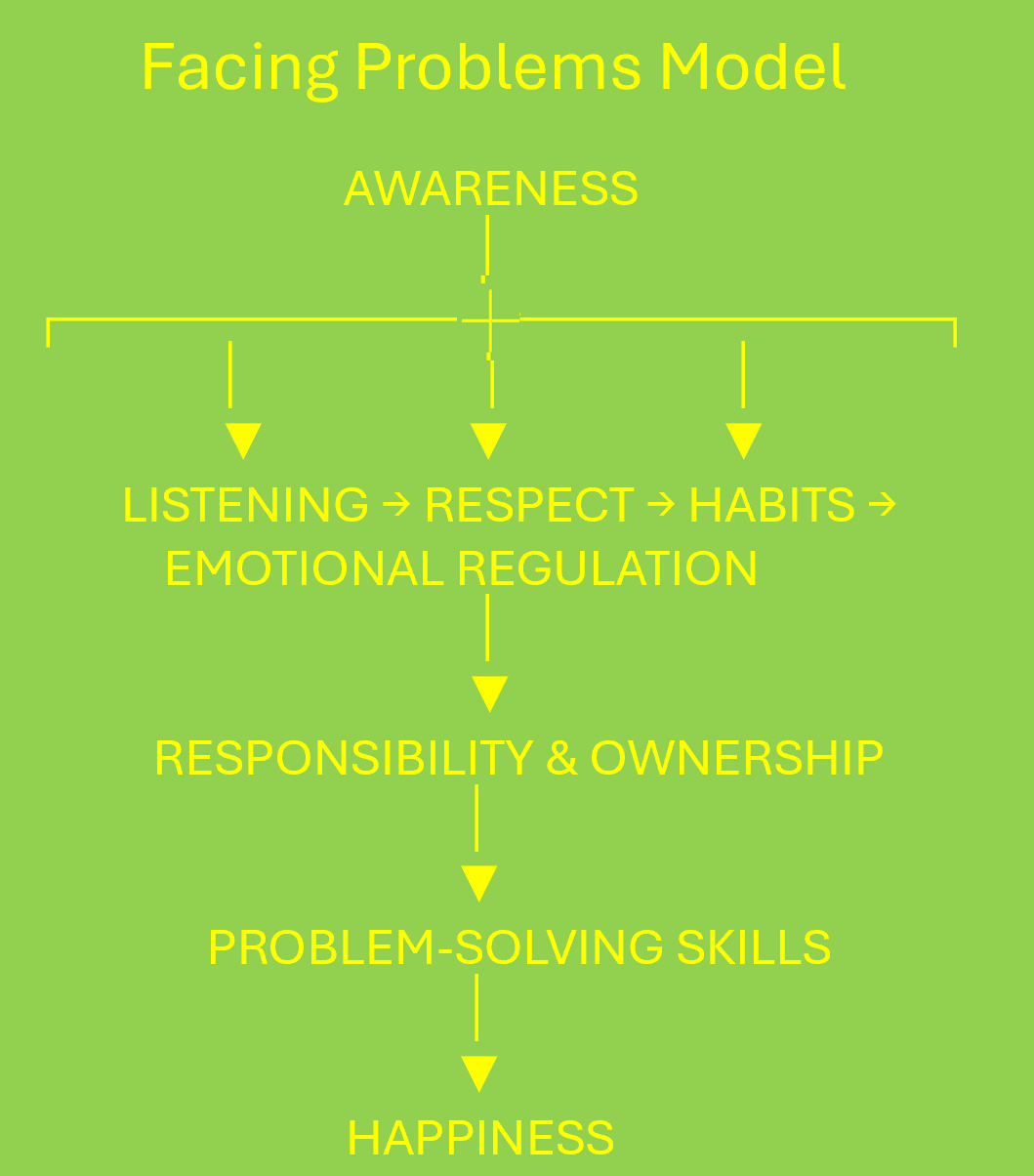
Facing Problems Path: Starts with awareness
- Listening Refer to Communication
- Listening all the way through without interruption
- Facing what bothers you instead of escaping
- Avoiding blame shifting and negative reactions
- Staying out of denial (“It has nothing to do with me”)
- Avoiding escapism: walking away, procrastinating, shutting down
- Avoiding helplessness (“I can’t do anything about it”)
- Responding to the issue instead of reacting or distracting
- Facing truth instead of avoiding it
- Reasoning with curiosity instead of judgment
- Respect
- Listening and responding appropriately
- Compassion with a willingness to learn and resolve
- Patience
- Avoiding self‑centered thinking, domination, and control
- Recognizing interconnectedness (Relational Science)
- Respect for people, living things, and the environment
- Respecting personal and natural boundaries
- Humility: accepting the possibility of being incorrect
- Recognizing human rights and nature rights
- Habits
- Everything we do today is built on past learning
- All learning stacks into habits, positive and negative
- Problem behaviors come from stacked habits in the past
- Growth requires examining old patterns and habits
- Most negative habits are early developmental defense/security habits
- Negative bias is inherited and developmentally normal
- Positive mindful solutions are not habitual for most people
- Neuroplasticity: habits can be changed with repetition
- Automaticity: habits run before awareness unless interrupted
- Identity: habits shape our identity, so change feels threatening to our being
- Emotional Regulation
- Emotional awareness is the foundation of healthy reasoning and behavior.
- The ability to pause when threatened or angered is a key to emotional regulation
- The ability to calm the body is a core skill of emotional regulation
- The ability to choose a reasoning response instead of an emotional one is a defining skill of emotional maturity.
- An ability to tolerate discomfort is a fundamental capacity of emotional maturity
- Key Elements of Responsibility & Ownership
- Owning our reaction is a core element of emotional maturity
- Being able to admit our responsibility in a problem is a core marker of maturity
- Choosing intentional action is the shift from impulse to deliberate behavior
- Avoiding outsourcing responsibility means refusing to shift blame or distract
- Problem‑Solving Skills
- Identifying the root of a problem is essential
- Facing truth is the foundation of all effective problem‑solving
- Understanding that emotional reasoning is different from reasoning is essential for effective problem‑solving
- Breaking complex problems into manageable steps is a foundational problem‑solving skill
- Being open to evaluating a full range of unbiased possible options is essential for effective problem‑solving
- Taking action to solve the problem is the goal
- Following through and reassessing truth is another goal
- Learning from outcomes is healthy, positive problem‑solving
- Letting go of fears that limit clarity, choices, or action is a must
- Prioritizing all positive, constructive options first, leaving negative or restrictive measures as the last alternative, is essential
- Placing problems upfront and addressing them sooner is effective living, while recognizing that some problems require time for careful analysis
- Happiness
- Happiness is a by‑product of facing problems early
- Happiness grows from reducing fear, avoidance, and reactivity
- Happiness requires positive habits replacing defensive ones
- Happiness comes from respect, connection, and relationships
- Happiness requires intention and daily practice
- Happiness is supported by emotional regulation and awareness
- Happiness increases when actions align with values
- Happiness and peace require personal responsibility
Facing Problems
Your Accepted Mindful Solutions appear here
The purpose of this website is to lay a foundation for understanding human
behavior, including negative bias, reactive patterns, and communication
habits, so that we can understand the importance of taking time for reflection to develop
positive, mindful solutions that serve the best interests of all people
and the Earth. Prior to reaching that level it often helps to reflect and learn to
recognizw our own behavioral patterns, reactions, assumptions,
and the ways we communicate. We welcome mindful suggestions that are
constructive, respectful, and supportive of the well‑being of all people and
the planet we share.